How to Create Your First Plan on PlanMate
Turn an activity idea into a clear PlanMate listing with practical guidance on titles, venues, timing, capacity, preparation and publishing.
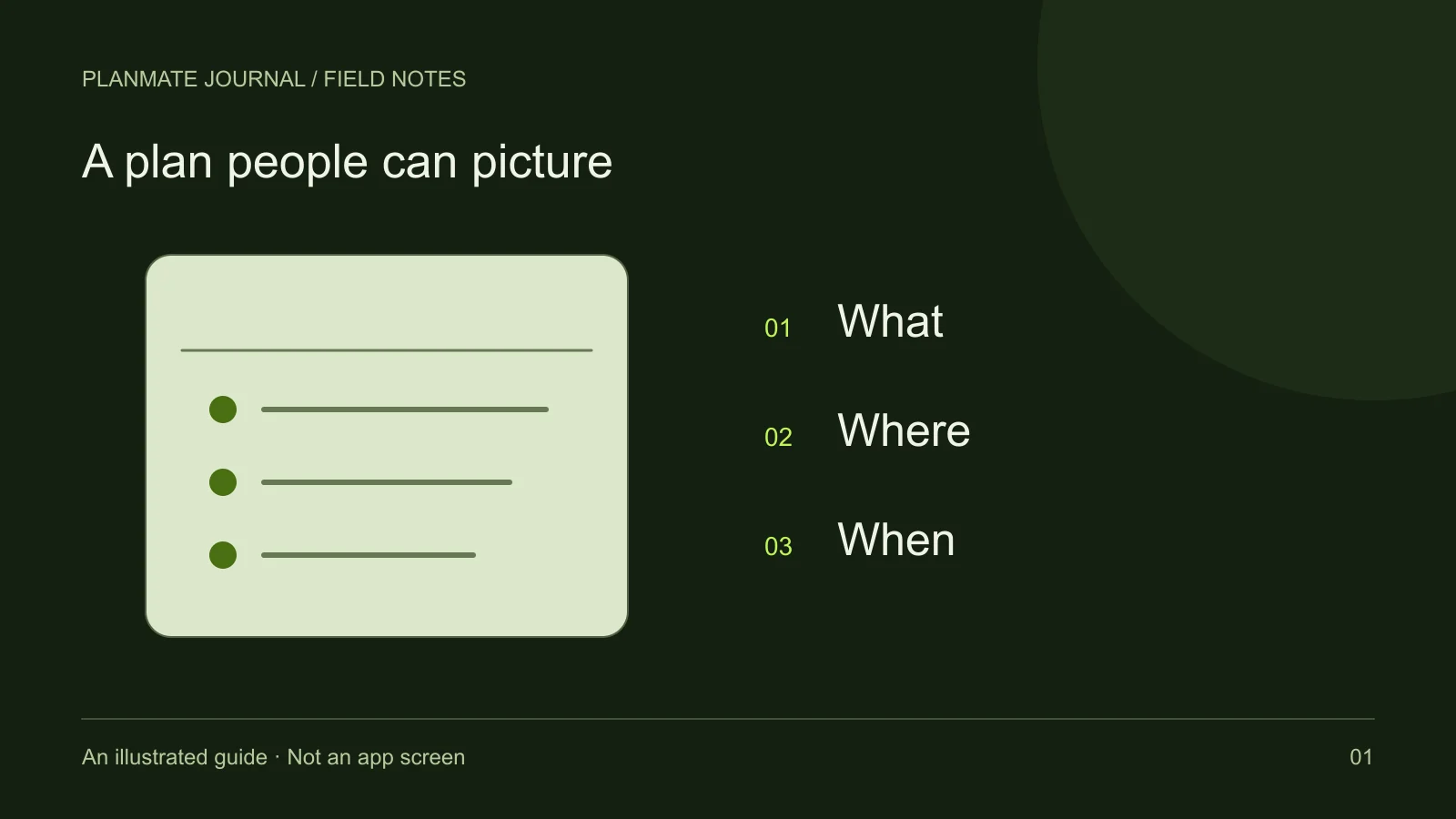
Before opening the plan editor, try writing the invitation in one sentence: “Beginner badminton on Sunday, 4–5 pm, at the public courts; bring a racket.” If you cannot yet name the place, time and preparation, those are the decisions to settle first.
PlanMate collects those details in a public activity listing. This guide follows the core creation fields, then covers what to check before publishing and what you owe participants afterward. Treat the description and venue as public information.
Decide what you can comfortably host
Start with one activity and one clear outcome. “Try a short beginner-friendly walk and have time to talk” is manageable. “Explore the whole city, make close friends, and finish with a surprise venue” leaves too many decisions unresolved. A narrow scope makes timing, capacity, and preparation easier to explain.
Choose a group size you can welcome without becoming distracted. Think about the venue layout rather than selecting a large number because it sounds exciting. A small café table, a walking route, and a sports court have different practical limits. PlanMate lets you enter participant capacity, but the app cannot determine whether your chosen venue will accommodate the group comfortably.
Before opening the creation flow, note the activity, date, start time, expected finish, meeting place, and any costs outside the plan. If you still need permission from a venue, obtain it before presenting the arrangement as settled. Listing a location does not reserve a room or authorize an organized gathering there.
Choose a category and write a useful title
The app's categories include options such as Outdoors, Coffee, Sports, Arts, Food, Music, Wellness, Learning, Social, and Other. Choose the category that best describes what people will actually do. A coffee conversation about books is not necessarily a formal class; a park sketch session may fit Arts even though it happens outdoors.
Make the title specific enough to distinguish your activity without packing every detail into it. “Beginner badminton on Sunday afternoon” tells readers more than “Amazing weekend plan.” Avoid promises you cannot deliver, such as guaranteed friendships or a completely risk-free experience. An accurate title attracts people who want the activity you are prepared to host.
Use the description for the sequence of events. Explain the opening, the main activity, and the finish. If participants can leave early, say so. If the activity requires a fixed start, make that clear. Someone reading quickly should still understand whether the plan works for their schedule and level of confidence.
Make the meeting place unambiguous
Enter the venue and location carefully. Where the flow provides a map or coordinates, check that the selected point matches the meeting place rather than a similarly named business. A useful arrival instruction identifies a public landmark: the main entrance, a reception desk, or a named café counter.
Avoid publishing a home address, access code, or someone else's personal contact details. Do not assume that venue information is hidden from people who have not joined. If a gathering requires confidential logistics, first establish what the platform actually supports rather than putting sensitive information into a public description.
Think through a late-arrival question before it happens. Could someone find the group if they arrive ten minutes after the start? If the activity moves away from the meeting point, explain the departure time. A host should not need to spend the entire meetup answering “Where are you?” messages.
Set timing, capacity, and preparation notes
Choose a date, start time, and duration that leave room for arrivals and a natural finish. Distinguish a proposed activity from a venue's opening hours. If the meeting lasts an hour, do not imply that participants must stay for the entire afternoon. Clear boundaries make a first meetup easier to accept.
Use the experience-level and preparation fields to remove uncertainty. “All levels” works only if you can genuinely accommodate beginners. List necessary equipment and separate it from optional items. A water bottle may be sensible; specialist equipment may be essential. Participants should not discover a major requirement after they arrive.
If the plan has a price, describe what it covers accurately. If it is free to join but attendees buy their own drinks or pay a venue directly, explain that distinction in plain language. Do not promise payment availability, a refund outcome, or a host payout based solely on a price field. Refer readers to the terms currently displayed in their app.
Preview the plan as a first-time reader
Read your preview without relying on knowledge in your own head. Replace “the usual entrance” with an actual landmark. Replace “bring the normal gear” with a short list. Remove personal details from photos and use only media you are entitled to share. Upload support can depend on the device and app version.
An illustrative description might read: “Meet at the library's public entrance at 11:00. We will sketch nearby for about an hour and finish at the same entrance. Bring a notebook and pencil. Beginners are welcome, and sharing your sketch is optional. If the weather is unsuitable, I will update the plan.” This is a writing example, not a live listing.
Check the publishing result rather than assuming the plan is visible as soon as you dismiss the editor. Media and activity details may take time to process. If publishing reports an error, follow the offered recovery path and avoid creating repeated copies just because the first attempt feels slow.
Your work continues after publishing
Once requests arrive, review them and maintain a realistic participant list. Pending applicants should not be counted as confirmed attendees. Use the activity communication tools to clarify relevant details, and keep updates consistent with the listing. The host management guide covers these responsibilities.
If you change the venue or timing, consider whether the change still works for people who joined. If you cannot host, cancel clearly rather than leaving an apparently active plan unattended. If the idea worked well, you can plan another occasion without promising automatic recurrence.
Before your first gathering, read how to organize a group meetup. A clear plan, a thoughtful welcome, and a practical finish matter more than making your first activity look like a major event.